Structured RerF Demo: Impulse Response
We form a two-class classification problem where each data point is 100 timesteps. Class 0 is simply white noise while class 1 is white noise plus an exponentially decaying unit impulse beginning at timestep 20.
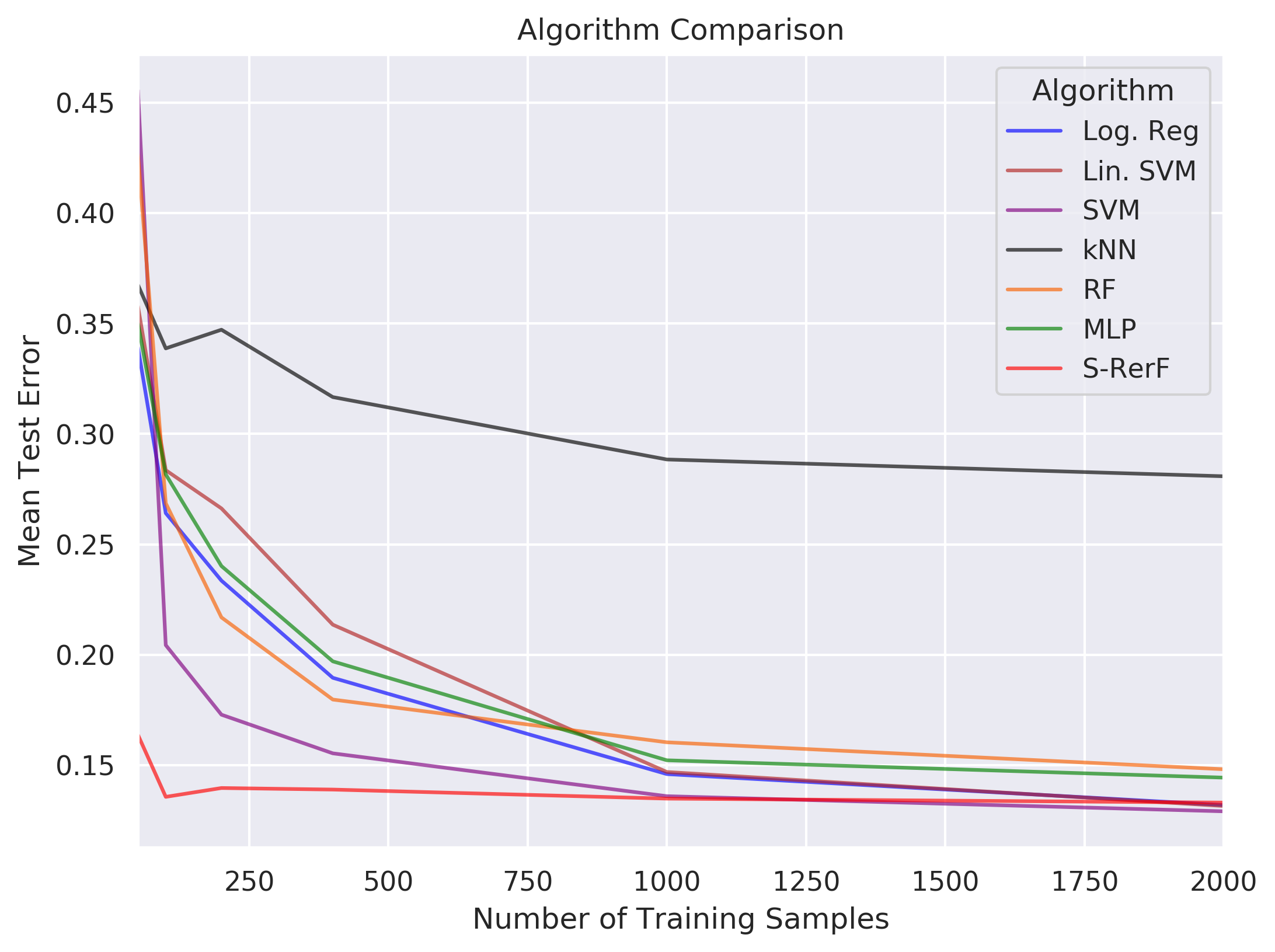
We test the performance of S-Rerf and a set of other classification algorithms, training each on samples of sizes \(n \in \{50,100,200,400,1000,2000\}\), each containing an equal number of data points in each class. The average 0-1 loss is evaluated for each algorithm for each training size using a single test set of size \(m=10000\) with an equal number of data points in each class.
import numpy as np
import pandas as pd
from scipy import stats

import matplotlib
import matplotlib.pyplot as plt
from matplotlib.colors import ListedColormap
%matplotlib inline
import seaborn as sns

import pickle
import time
from tqdm import tqdm

from sklearn.linear_model import LogisticRegression
from sklearn.svm import LinearSVC
from sklearn.svm import SVC
from sklearn.ensemble import RandomForestClassifier
from sklearn.neural_network import MLPClassifier
from sklearn.neighbors import KNeighborsClassifier

from rerf.rerfClassifier import rerfClassifier

import warnings
warnings.simplefilter('ignore')
def samp(n, cls=0):
    ## Sample n samples from either class 0 or 1
    M0 = 20 # Onset of impulse response
    M1 = 100-M0
    func = lambda x: [np.exp(-0.1*(j-M0)) if j >= M0 else 0.0 for j in x] # Impulse response function
    if cls == 0:
        X = np.full((n,M0+M1),0.0)
        Y = np.full(n,cls)
    elif cls == 1:
        X = np.tile(func(np.arange(0,M0+M1)),reps=(n,1))
        Y = np.full(n,cls)

    # White noise
    X += np.random.normal(0,1,size=(n,M0+M1))

    return(X,Y)

def mixed_samp(n0,n1,shuffle=True):
    ## Generate a collection of mixed class (shuffled) observations
    X0,Y0 = samp(n0,cls=0)
    X1,Y1 = samp(n1,cls=1)
    X = np.vstack([X0,X1])
    Y = np.hstack([Y0,Y1])
    if shuffle:
        shuffled_idx= list(range(n0+n1)); np.random.shuffle(shuffled_idx)
        X = X[shuffled_idx]
        Y = Y[shuffled_idx]
    return(X,Y)
np.random.seed(1234)
ns = np.array([50,100,200,400,1000,2000])
TRAIN_FRAC = 0.5
n0 = [int(i*TRAIN_FRAC) for i in ns]
n1 = n0

X_train, Y_train = np.empty(shape=(0,100)), np.empty(shape=(0))
for l0,l1 in zip(np.append(n0[0],np.diff(a=n0)),
                 np.append(n1[0],np.diff(a=n1))):
    x, y = mixed_samp(l0,l1)
    X_train = np.vstack((X_train, x))
    Y_train = np.hstack((Y_train, y))

TEST_SIZE = 10000
X_test, Y_test = mixed_samp(int(TEST_SIZE*0.5),int(TEST_SIZE*0.5))
## Setup for run
names = {"Log. Reg": "blue", "Lin. SVM":"firebrick", "SVM":"purple",
          "kNN": "black", "RF":"#f86000", "MLP":"green", "S-RerF":"red"}

ncores=1
num_runs=1
n_est=100

classifiers = [
    LogisticRegression(random_state=0, n_jobs=ncores, solver='liblinear'),
    LinearSVC(),
    SVC(C=1.0, kernel='rbf', gamma='auto',random_state=0),
    KNeighborsClassifier(3, n_jobs=ncores),
    RandomForestClassifier(n_estimators=n_est, max_features='auto', n_jobs=ncores),
    MLPClassifier(hidden_layer_sizes=(100, ), random_state=0, max_iter=1000),
    rerfClassifier(projection_matrix="S-RerF",
                   max_features='auto',
                   n_jobs=ncores,
                    n_estimators=n_est,
                    oob_score=False,
                    random_state=0,
                    image_height=1,
                    image_width=100,
                    patch_height_max=1,
                    patch_height_min=1,
                    patch_width_max=20,
                    patch_width_min=2
                   )
    ]
# Train each classifier on each dataset size, then test
## Prep output file:
f = open('s-rerf_impulse_experiment.csv', 'w+')
f.write("classifier,n,Lhat,trainTime,testTime,iterate\n")
f.flush()

runList = [(n, clf, run) for n in ns\
                       for clf in zip(classifiers, [key for key in names])\
                       for run in range(num_runs)]

for n, clf, iteration in tqdm(runList):
        X = X_train[:n]
        y = Y_train[:n]

        trainStartTime = time.time()
        clf[0].fit(X, y)
        trainEndTime = time.time()
        trainTime = trainEndTime - trainStartTime

        testStartTime = time.time()
        out = clf[0].predict(X_test)
        testEndTime = time.time()
        testTime = testEndTime - testStartTime

        lhat = np.mean(np.not_equal(out, Y_test).astype(int))


        ####("variable,Lhat,trainTime,testTime,iterate")
        f.write(f"{clf[1]}, {n}, {lhat:2.9f}, {trainTime:2.9f}, {testTime:2.9f}, {iteration}\n")
        f.flush()

f.close()
100%|██████████| 42/42 [01:38<00:00, 8.28s/it]
dat = pd.read_csv("s-rerf_impulse_experiment.csv")

d1 = pd.DataFrame(columns = ['classifier', 'n', 'Lhat', 'color'])

k = 0
for ni in np.unique(dat['n']):
    for cl in np.unique(dat['classifier']):

        tmp = dat[np.logical_and(dat['classifier'] == cl,dat['n'] == ni)][['n', 'Lhat']]

        list(tmp.mean())
        d1.loc[k] = [cl] + list(tmp.mean()) + [names[cl]]
        k += 1


sns.set(style="darkgrid", rc={'figure.figsize':[12,8], 'figure.dpi': 300})
fig, ax = plt.subplots(figsize = (8,6))

for key in names.keys():
    grp = d1[d1['classifier'] == key]
    ax = grp.plot(ax=ax, kind='line', x='n', y='Lhat', label=key, \
            c = names[key], alpha =0.65)
    #ax.set_yscale('log')

plt.legend(loc='best',title='Algorithm')
plt.title('Algorithm Comparison')
plt.ylabel('Mean Test Error')
plt.xlabel('Number of Training Samples')
#plt.savefig('./s-rerf_impulse_experiment.pdf',dpi=300,format='pdf')
plt.show()